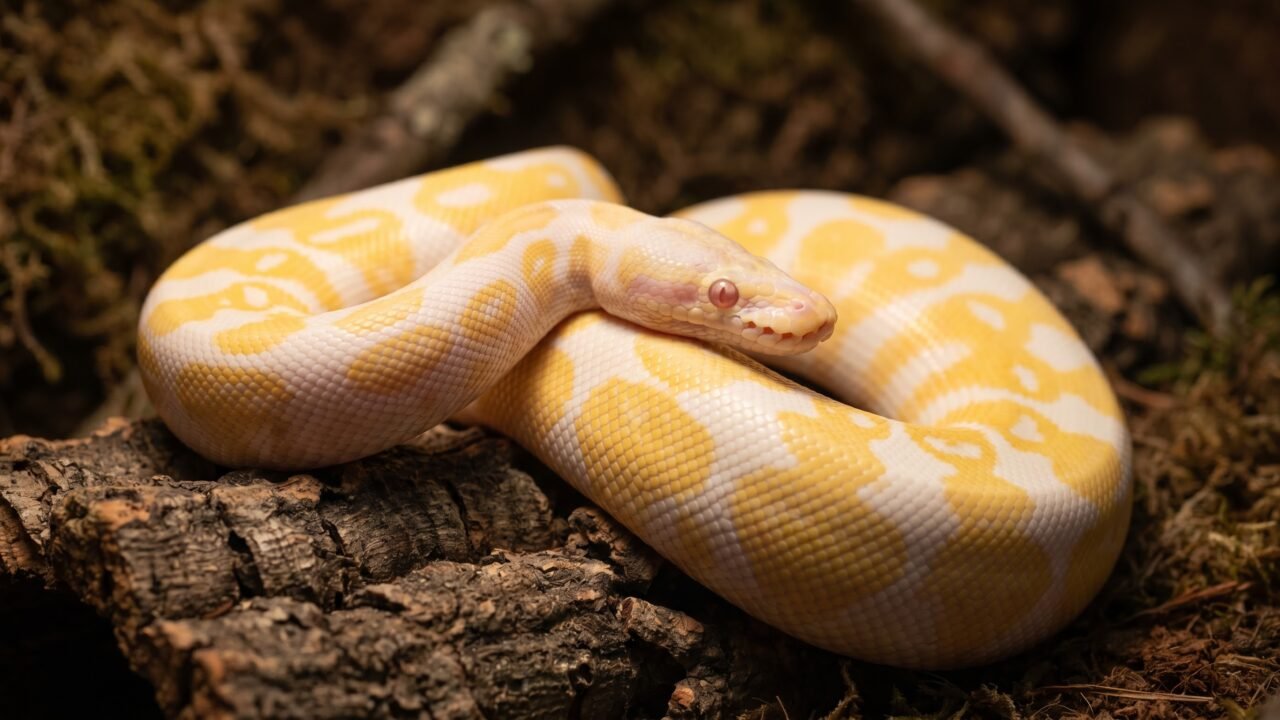
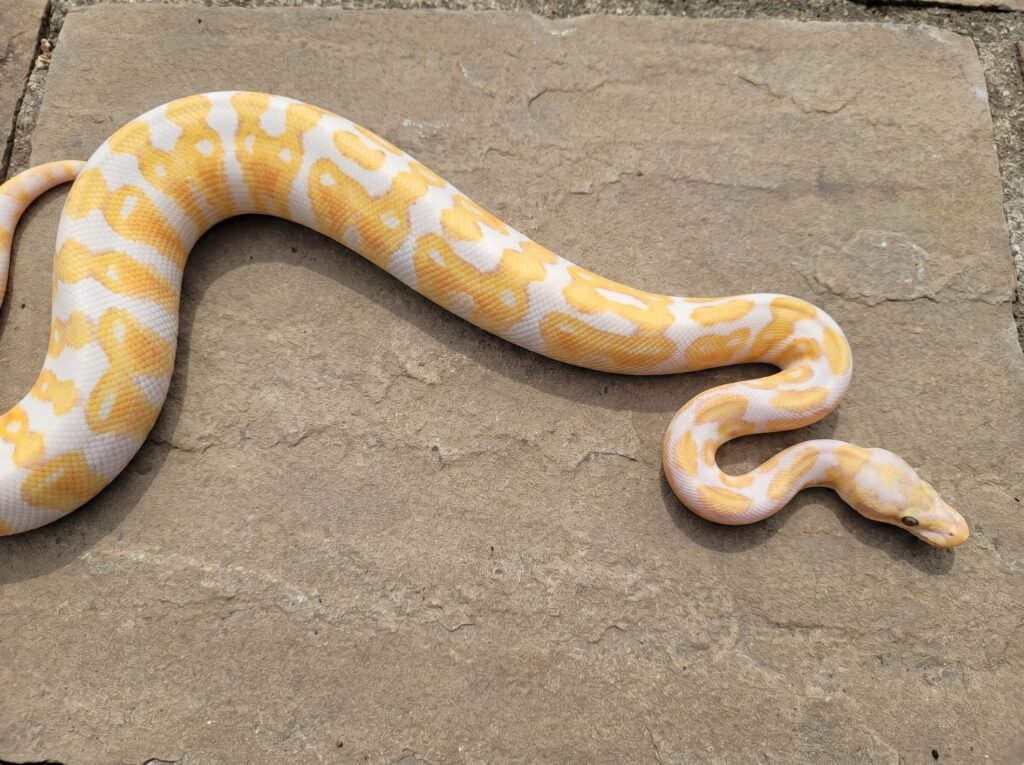
The albino ball python is bright yellow and white, with pink or red eyes that glow under the light. That coloring comes from amelanism: a complete absence of melanin, the pigment responsible for every dark scale on a normal ball python. Take melanin away and the black and brown vanish, leaving the yellow background pattern to shine on its own. It's one of the most recognizable looks in the hobby, and it's been here since the very beginning.
Everything else about keeping an albino is the same as keeping any other ball python. The morph changes pigment, but temperature, feeding, humidity, and enclosure needs stay identical. If you're new to the species, the full rundown lives at our ball python care guide.
What an albino ball python looks like
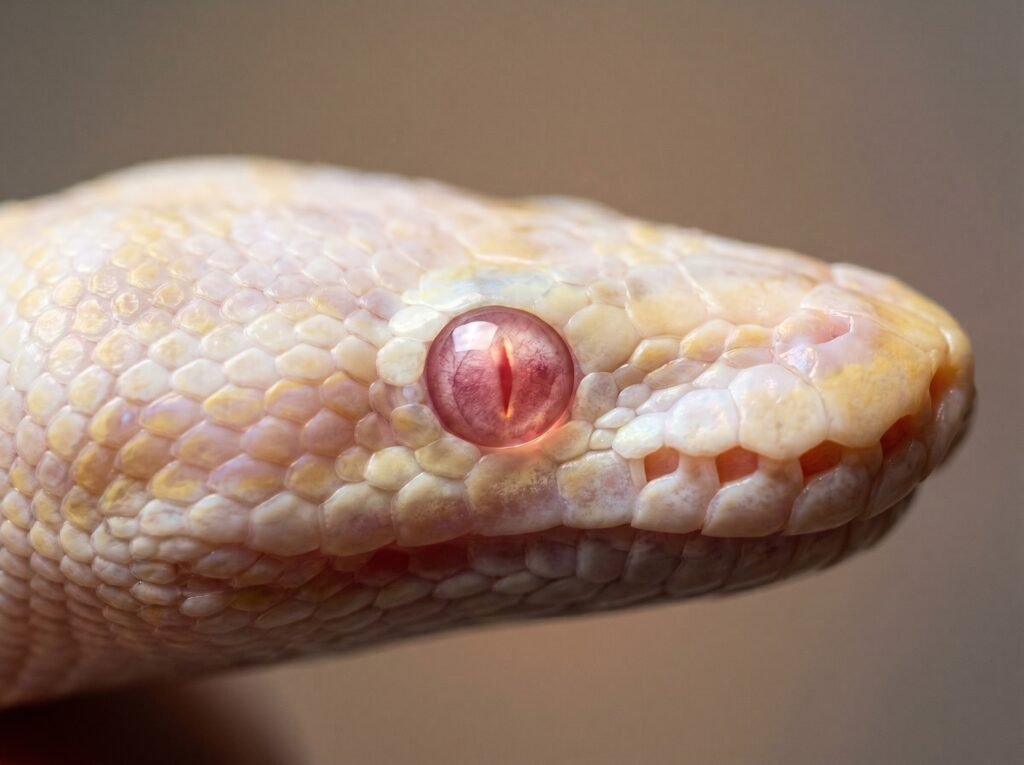
Wild-type ball pythons are dark brown with tan pattern. An albino replaces all of that with yellow pattern on a white or cream background. The eyes are pink or red, a result of blood vessels showing through unpigmented irises. There are no dark outlines around the pattern, so the contrast between yellow and white is softer than on a normal ball python.
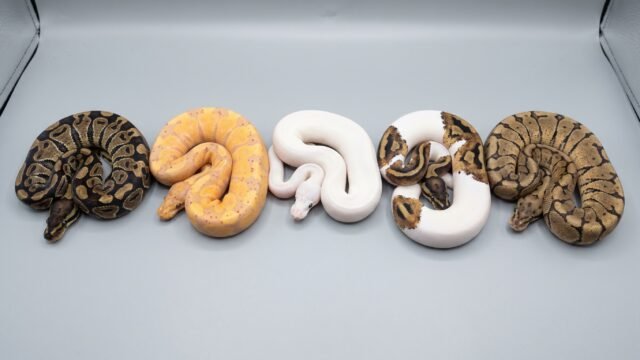
Two informal varieties exist among breeders. High-contrast animals keep a strong white-to-yellow distinction throughout their lives. Low-contrast animals gradually lose the white and become mostly yellow as they age. Breeders who want vivid high-contrast offspring tend to select high-contrast het parents with strong dark patterning, since that underlying template still influences how bright the yellow reads even without dark pigment showing.
Albinos also carry alleles that interact with related mutations at the same gene locus. Candy and Toffee sit at the same TYR locus as albino, current molecular evidence suggests they may represent the same allele discovered independently. Breeding any two of these three together produces visually interesting intermediates called candinos and tofinos. Our genetics primer explains how allelic morphs interact.
Albino ball python genetics at a glance
Albino inheritance is simple recessive. A snake needs two copies of the albino allele to express the look; one copy produces a visually normal "het albino" that carries the gene invisibly. When two hets are bred together, roughly one in four offspring will be visual albinos, one in two will be single-copy hets, and one in four will carry no albino allele at all.
The mutation is caused by variants in the TYR gene, which encodes tyrosinase, the enzyme that starts the chemical pathway converting the amino acid tyrosine into melanin. When tyrosinase is non-functional, the pathway stalls and no melanin is made. This specific form is called a tyrosinase-negative (T-negative) albino, sometimes labeled "amelanistic" in morph lists, per MorphMarket Morphpedia.
Bob Clark Reptiles produced the first visual albino in 1992, according to World of Ball Pythons. It was the first proven recessive ball python mutation. That distinction made albino the template for understanding recessive genetics in the hobby, and the foundation for nearly every multi-gene designer project that came after.
Albino ball python profile
| Feature | Detail |
|---|---|
| Coloration | Yellow pattern on white/cream background; no dark pigment |
| Eye color | Pink or red (unpigmented irises reveal blood vessels) |
| Alternate names | Amelanistic, T-negative albino |
| Inheritance | Simple recessive (two copies needed to express) |
| Gene locus | TYR (tyrosinase); allelic with Candy and Toffee |
| First produced | Bob Clark Reptiles, 1992 |
| Typical price, simple albino hatchling | $150 to $200 (USD, captive-bred) |
| Typical price, multi-gene combos | $300 to $800+ depending on genes; dreamsicle $600 to $1,500+ |
| Popular combos | Albino pied, pastel albino, banana albino, candino, dreamsicle (lavender albino pied) |
| Welfare flag | Increased UV sensitivity; lower UVI cap recommended (see below) |
Price and what drives it
Simple albino hatchlings from reputable breeders typically list between $150 and $200 on sites like MorphMarket. That price is stable. Albino has been in the hobby for over 30 years and is one of the most commonly produced morphs. Supply is high, so entry cost is low.
Combos move the price considerably. An albino pied (which combines the yellow-and-white albino base with piebald's solid white body patches) tends to run $500 to $800. A dreamsicle, the lavender albino piebald, has dropped significantly from five figures in its early days and now typically runs $600 to $1,500 for quality hatchlings. The more recessive genes required, the harder the project and the higher the price.
Sex also affects cost. Females almost always list higher than males because females are essential for any breeding program. A female albino may be priced $50 to $100 above an equivalent male from the same clutch.
Browse current listings and compare prices across multiple sellers at MorphMarket's albino ball python listings. Prices shift seasonally, so what you see today is the most reliable reference.
Popular combos worth knowing
Albino has been a building block in designer projects since the 1990s. A few combos appear on most breeders' project lists.
- Pastel albino: Pastel amplifies yellow, making the contrast between pattern and background more vivid. A reliable, approachable combo.
- Albino pied: Two recessives combined. The piebald gene adds solid white blotches to the body, so the animal's yellow pattern appears in islands against white.
- Banana albino: Banana (co-dominant) adds freckling and an orange-pink flush over the albino base. The combination looks nearly identical to a standard albino at hatch but develops differently with age.
- Candino / tofino: Breeding albino to Candy or Toffee (morphs at the same TYR locus) produces intermediates with additional color shifts.
- Dreamsicle (lavender albino pied): One of the most visually striking ball pythons produced. Three genes, significant project depth, still one of the most sought-after animals in the hobby.
For a wider look at where albino fits in the morph world, see our guide to ball python morphs and the most popular ball python morphs breakdown.
One care tweak albinos need
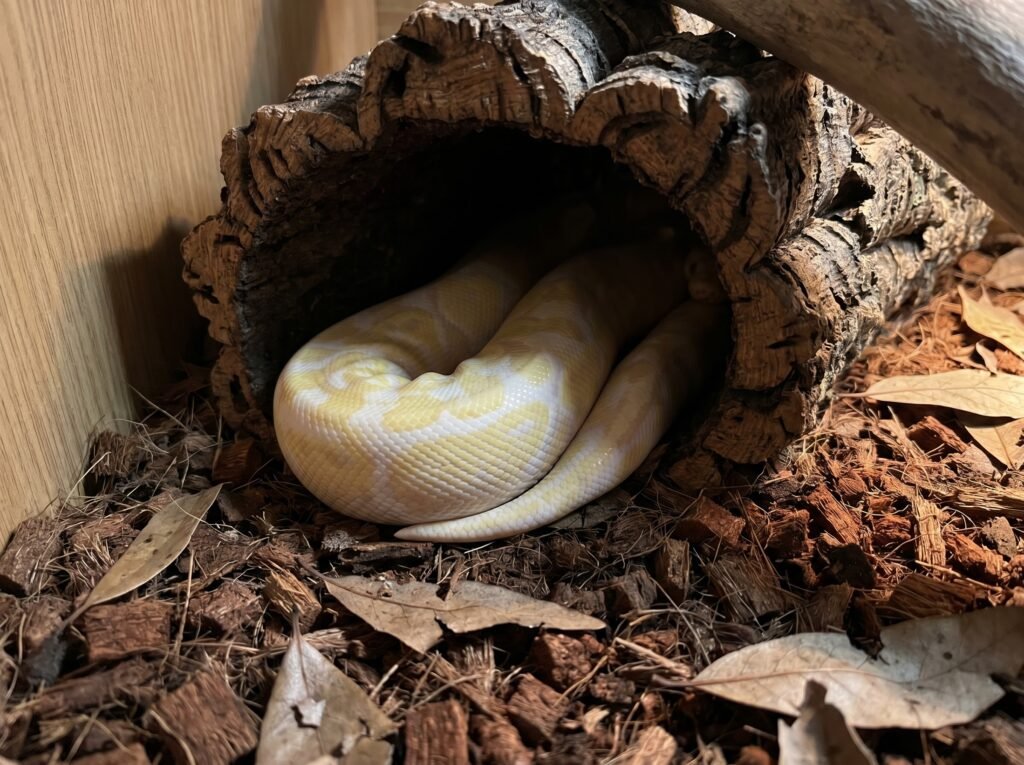
Albino ball pythons require the same husbandry as any ball python. Same temperatures. Same feeding schedule. Same enclosure setup. The morph does not change their basic biology.
One adjustment is worth making if you use UVB lighting. Melanin normally protects skin and eyes from ultraviolet radiation. Albinos have none. Their red eyes are especially vulnerable to overexposure. The RSPCA recommends a maximum UVI of 0.7 in the basking zone for albino morphs, compared to 1.0 for standard ball pythons. In practical terms: use a low-output 5.0 UVB tube, position it at least 12 to 18 inches above the basking spot, and make sure the enclosure has plenty of shaded hides so the snake can move away from the light entirely. If you see squinting or excessive hiding near the light, reduce exposure.
Albinos are healthy, straightforward animals when kept correctly. They feed well, shed normally, and live full lives under standard ball python husbandry with the one lighting adjustment above.