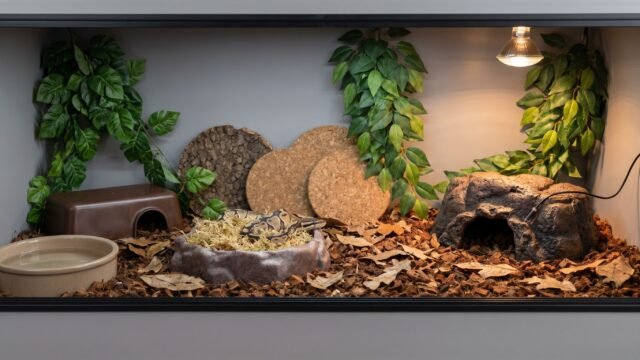
Ball pythons are ectotherms, meaning they rely entirely on their environment to manage body temperature. Get the thermal gradient right and your snake digests meals properly, sheds cleanly, and stays active. Get it wrong and you will see refused food, poor sheds, and eventually a compromised immune system. This guide covers every zone you need, the heat sources that are worth your money, and the one piece of equipment that makes all of it safe.
A warm hide air temperature of roughly 88-92°F (31-33°C), a cool side of 75-80°F (24-27°C), and a thermostat on every single heat source are the three things that matter most. Everything below explains why those numbers exist, where the published sources disagree, and how to set it all up correctly.
The temperature zones your ball python needs
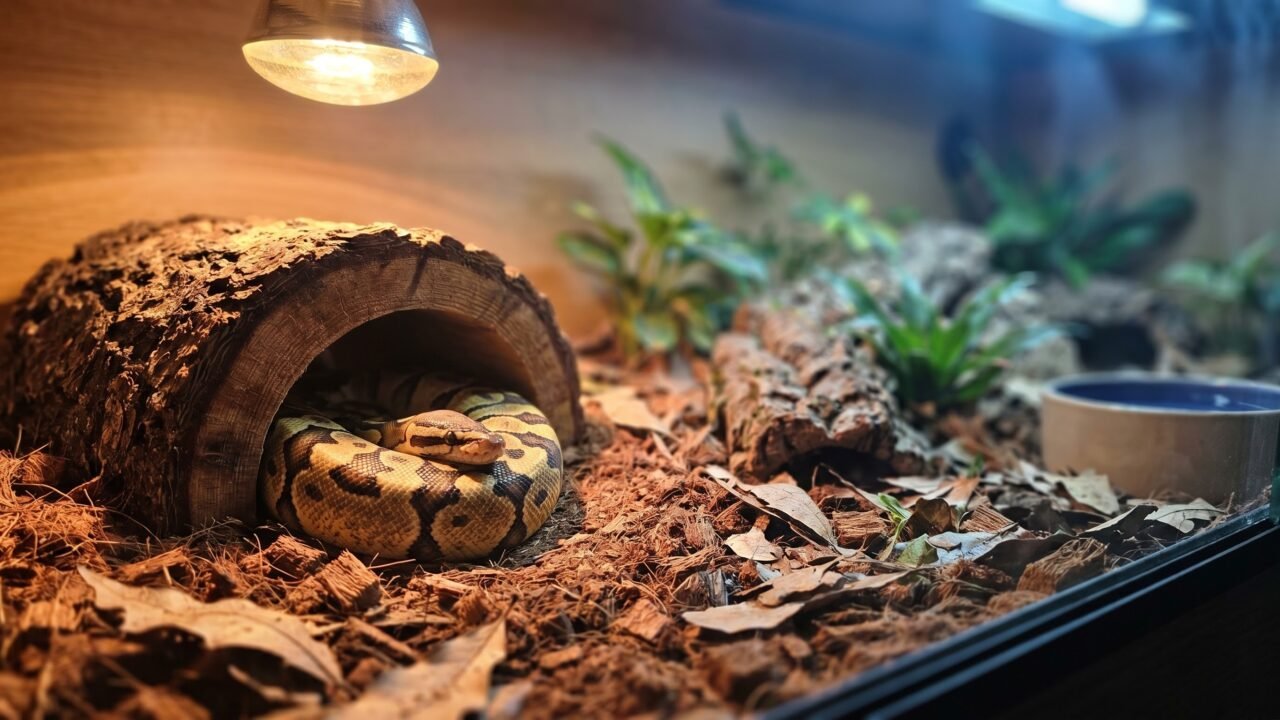
A thermal gradient means your snake has a warm end and a cool end and can move between them at will. Ball pythons do not bask openly the way a bearded dragon does. They thermoregulate inside hides. That distinction matters for how you measure and control the heat.
The table below pulls the key zones together in one place. Use it as a daily reference.
| Zone | Target range | Where to measure | Tool |
|---|---|---|---|
| Warm hide (air inside) | 86-90°F (30-32°C) | Inside the hide, at substrate level | Digital probe thermometer |
| Basking surface under heat source | 95-104°F (35-40°C) | Surface of flagstone or substrate below lamp | Infrared temperature gun |
| Warm-side ambient air | 80-85°F (27-29°C) | Midpoint of warm half, 4-6 inches above floor | Digital probe thermometer |
| Cool side (cool hide) | 72-80°F (22-27°C) | Inside cool hide, at substrate level | Digital probe thermometer |
| Ambient air (whole enclosure) | Must not exceed 95°F anywhere | Both ends; use two thermometers | Digital probe or combo unit |
| Nighttime (lights off) | 72-78°F (22-26°C) | Coolest corner of enclosure | Digital probe thermometer |
Sources: Zen Habitats / ReptiFiles care sheet (zenhabitats.com) and the Zen Habitats lighting and heating guide.
Adjudicating the warm-side numbers: 88-92°F or 90-95°F?
You will see both ranges on reputable sites. They are not actually in conflict. The 90-95°F figure describes the floor or substrate surface on the warm side, measured with a temperature gun. The 86-90°F figure describes the air temperature inside the warm hide, measured with a digital probe. Surface temperatures run warmer than air temperatures above them. Both readings can be correct in the same enclosure at the same time.
ReptiFiles and Zen Habitats consistently use 90-95°F for warm-side floor surface readings. The same sources use 86-90°F for the air inside the warm hide. Across the reptile-keeping community, a warm hide air reading of 88-92°F is widely cited as the practical target, and that falls right between the two published figures. In practice: aim for 88-90°F air inside the warm hide, and let the surface beneath the heat source sit naturally at 95-100°F. If either extreme is off, adjust the heat source or the thermostat setpoint, not both at once.
The number that matters most for your snake is the one it actually experiences: inside the hide, at substrate level, measured with a probe. That is where the thermostat probe should live too. More on that in the full thermal gradient deep-dive.
Why thermostats are mandatory, not optional
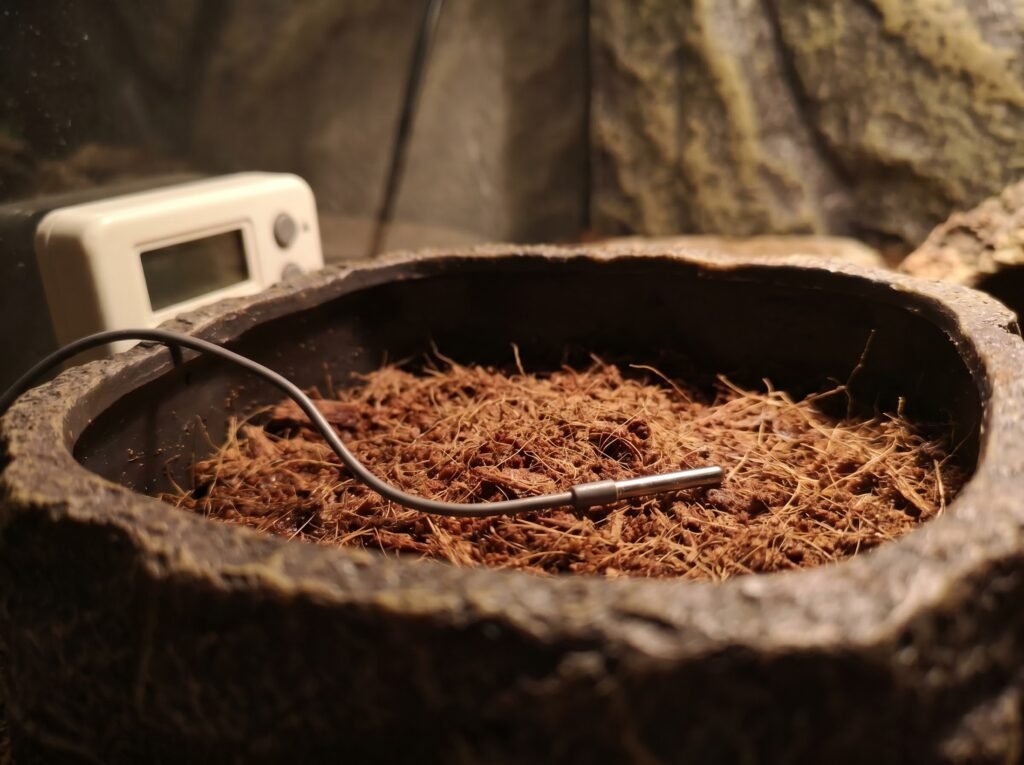
The Merck Veterinary Manual is direct on this: heat sources must be attached to programmable thermostats that turn the heat on and off automatically, and the manual notes that temperatures exceeding the upper safe limit by only 10°F may prove fatal for some species. Ball pythons cannot sweat or pant effectively. They have no way to escape a runaway heat source inside an enclosed terrarium. An overheated hide is a dead end.
Every heat source in the enclosure needs its own thermostat. Heat mats, heat tape, ceramic heat emitters, radiant heat panels, all of them. Overhead halogen bulbs need a dimming thermostat (which dims the output gradually to hold a setpoint). Heat mats and ceramics work better with a pulse proportional thermostat (which cycles power in short bursts for finer control). A simple on/off thermostat is functional but produces more temperature swing than the other two types.
Probe placement makes or breaks thermostat performance. The probe should rest inside the warm hide, sitting on top of the substrate at the level your snake actually occupies. If the probe is outside the hide or mounted on the wall of the enclosure, the thermostat is measuring the wrong thing. For a detailed walkthrough of thermostat types, setpoints, and wiring, see the ball python thermostat guide.
Comparing heat sources: what works and what to skip
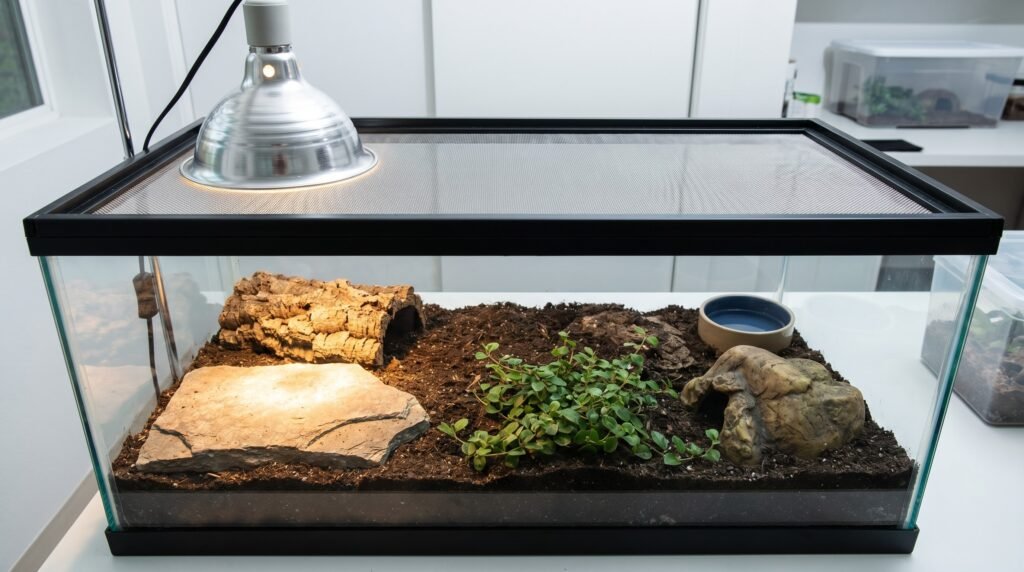
The table below covers the most common options. The judgment column reflects the consensus view from experienced keepers and the Zen Habitats technical guides.
| Heat source | Mechanism | Best for | Thermostat type | Verdict |
|---|---|---|---|---|
| Halogen flood bulb (PAR38, 90-100w) | Radiant overhead heat + visible light | Primary daytime heat, warm basking surface | Dimming thermostat | Best all-around; deep infrared penetration, natural light spectrum |
| Ceramic heat emitter (CHE) | Radiant heat, no light | Supplemental or nighttime heat | Pulse proportional | Good for night; does not disturb light cycle |
| Deep heat projector (DHP) | Infrared-B/C, deep tissue warming | Supplemental warmth, large enclosures | Dimming thermostat | Excellent penetration; pricier; growing community support |
| Radiant heat panel (RHP) | Overhead radiant, no light | Large PVC enclosures, ambient warmth | On/off or pulse proportional | Great for maintaining ambient; less precise basking surface |
| Heat mat / heat tape (UTH) | Conductive belly heat | Supplemental warm hide floor heat | Pulse proportional (mandatory) | Useful under warm hide; must run through thermostat, never bare |
| Heat rock | Resistive electric heating element | Nothing, avoid entirely | Cannot be properly regulated | Banned. Merck Vet Manual and every major care resource list these as a thermal burn hazard |
Heat rocks deserve a direct note. The Merck Veterinary Manual lists them explicitly as a burn hazard, stating that "hot rocks frequently result in burns in larger animals and should be avoided." Zen Habitats reinforces this: heat rocks "are unable to be properly regulated and are extremely unsafe heating elements that often lead to severe burns on reptiles." There is no scenario where a heat rock is safer than any of the other options on this list.
For a side-by-side breakdown with specific product examples and wattage guidance, the ball python heat source comparison goes deeper on each option.
Night temperatures and what happens when the lights go off
Ball pythons are naturally most active at dusk and at night. The ambient temperature in their range in West and Central Africa drops after dark, and captive snakes benefit from that same daily cycle.
Safe nighttime temperatures fall between 72-78°F (22-26°C) in the coolest corner of the enclosure. Do not let any part of the enclosure drop below 70°F. A ceramic heat emitter or deep heat projector on a separate thermostat handles overnight warmth without adding light that would disrupt the dark period. Turn off all visible-spectrum bulbs at night. Red night bulbs are a common mistake; Zen Habitats specifically notes that red light causes visual stress and serves no benefit.
If your home stays above 72°F at night, you may not need supplemental overnight heating at all. Check with a probe thermometer on the coolest night of the year before assuming the ambient is adequate.
Accurate measurement: where most setups go wrong
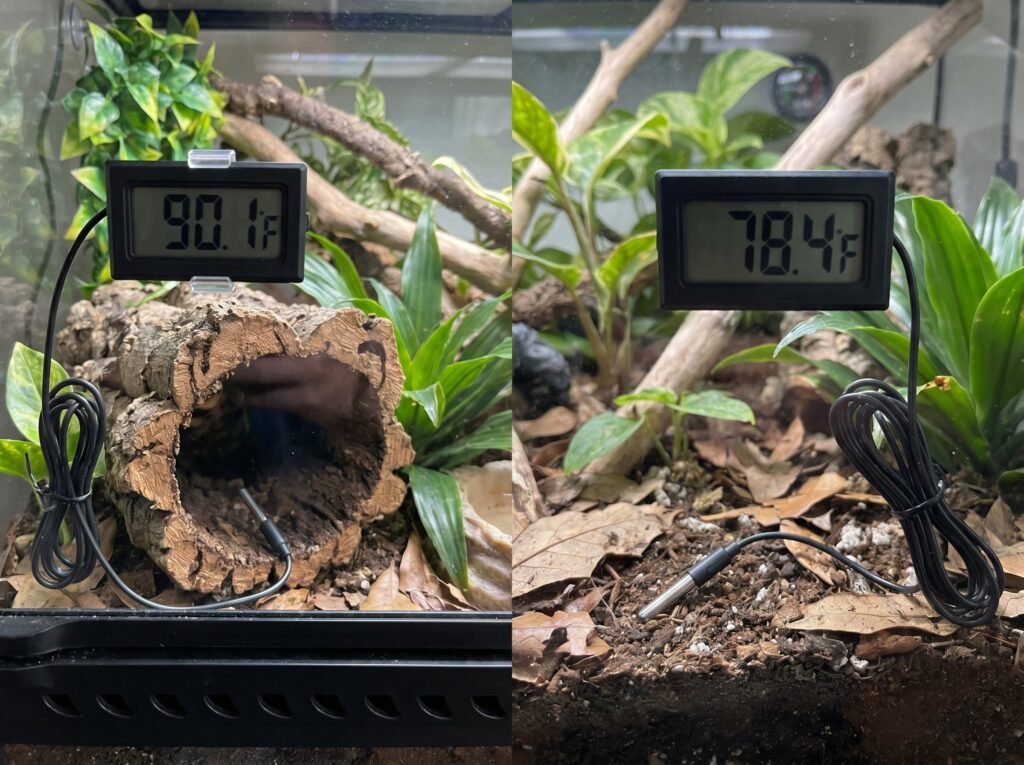
A cheap dial thermometer stuck to the side of the enclosure tells you almost nothing useful. You need two tools.
An infrared temperature gun reads surface temperatures in an instant. Point it at the flagstone or substrate directly below your heat source and you get the basking surface reading. The Merck Veterinary Manual recommends placing at least two thermometers in every reptile enclosure, one at each end. A digital probe thermometer placed inside the warm hide at substrate level gives you the air temperature your snake actually experiences there.
Combined digital thermometer/hygrometer units handle both temperature and humidity in one device. Humidity matters too: ball pythons need roughly 60-80% in the daytime, rising toward 80-100% at night as it does in their native range, and should have a humid hide lined with damp sphagnum moss during shed. The full humidity picture is covered in ball python humidity and shedding.
For a head-to-head look at specific thermometer and hygrometer products, see the guide to accurate thermometers and hygrometers.
UVB: optional or worth adding?
Ball pythons can survive without UVB. But "survives without" is a lower bar than "thrives with." Zen Habitats notes that ball pythons in the wild do engage in cryptic basking, exposing small parts of their body to filtered sunlight, and that UVB aids vitamin D3 synthesis and provides the UV spectrum these animals can actually see.
If you choose to add UVB, a 22-inch T5 HO low-intensity fluorescent tube works well in a 4x2x2 enclosure. Output degrades over time even when the bulb still glows, so replace it every six to 12 months. UVB cannot penetrate glass or solid plastic, so the tube must be inside the enclosure or directly over a mesh top. For setup specifics, placement heights, and which brands to consider, the ball python UVB guide covers it in full.