A properly set up enclosure is the single biggest factor in your ball python's health and behavior. Get it right and you will have a calm, feeding-well snake that barely keeps you guessing. Get it wrong and you will be troubleshooting stress behaviors, bad sheds, and respiratory infections for months. This guide covers every component of a correct setup, size, enclosure type, hides, substrate, temperatures, humidity, and water, so you can build or audit your snake's home with confidence.
One thing worth knowing from the start: the goal is security, not size. A large, empty enclosure leaves a ball python without anywhere to hide, and that exposure raises stress. What calms one is a space packed with hides and visual breaks, so the snake always has somewhere dark and snug to retreat to. We will come back to that throughout.
Anatomy of a correct setup, the reference table
Before diving into each component, here is the complete picture in one place. Every row is explained in detail below.
| Component | What | Why it matters |
|---|---|---|
| Enclosure size | 4 ft x 2 ft x 2 ft minimum for adults; smaller for hatchlings and juveniles (see enclosure size guide) | Allows a proper temperature gradient, exercise, and full stretch; undersized housing is an animal welfare failure |
| Enclosure type | Front-opening PVC or ABS preferred; glass possible but harder to hold humidity | PVC retains heat and humidity; front opening reduces startle responses and escape risk |
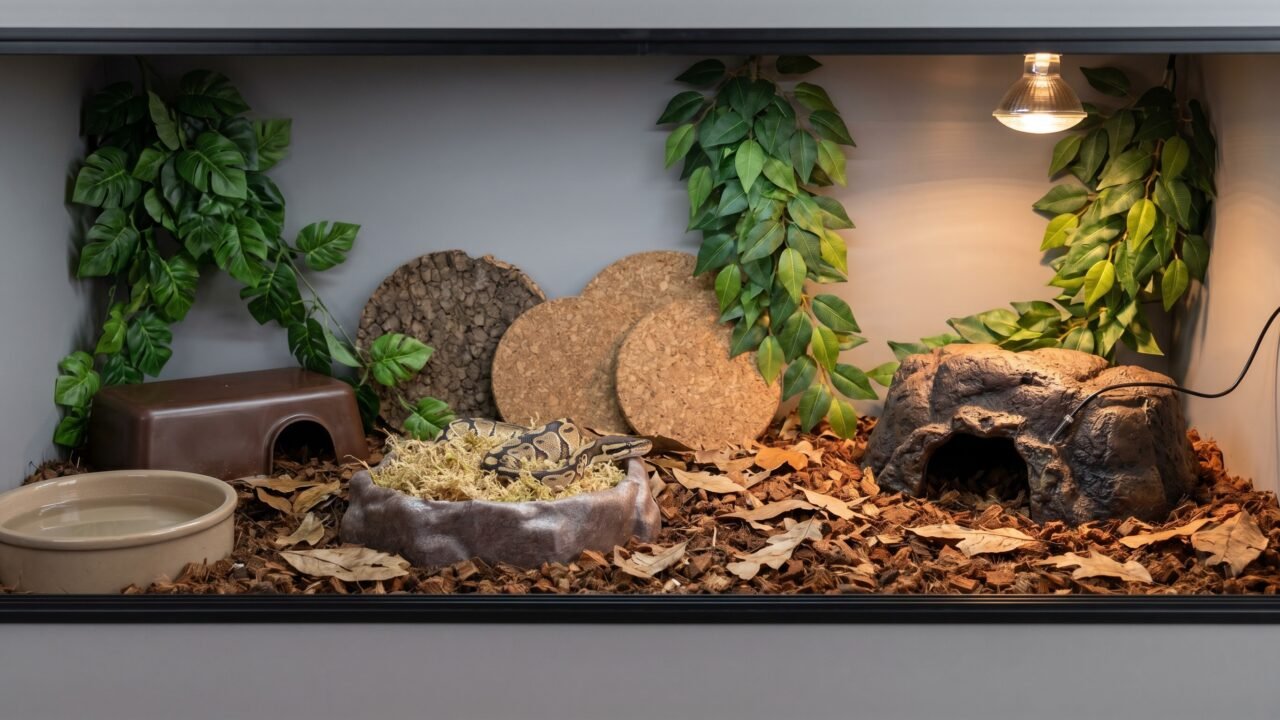
| Warm hide | Snug, opaque, on the warm end; sized so the snake fills it when coiled | Ball pythons use the warm hide for digestion and immunity; too large and it feels exposed |
| Cool hide | Snug, opaque, on the cool end | Gives the snake a secure retreat when thermoregulating down; prevents chronic stress |
| Humid hide | Middle to cool end; lined with moist sphagnum moss; replaced when it smells | Keeps skin hydrated before and during shed; critical for clean one-piece sheds |
| Water bowl | Heavy ceramic, large enough for full-body soak; fresh water always present | Ball pythons soak before shedding and when dehydrated; heavy bowl prevents tipping and substrate soaking |
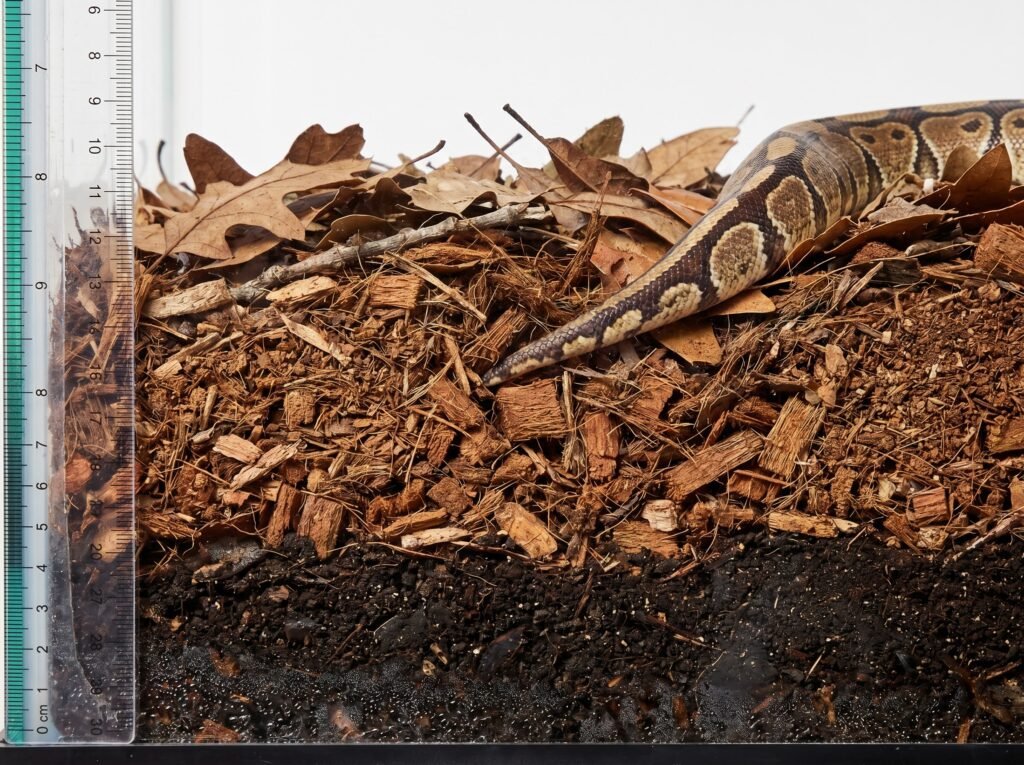
| Substrate | Organic topsoil, coco coir, cypress mulch, or a mix; 2-4 inches deep; leaf litter on top | Retains humidity, allows burrowing, mimics natural habitat; loose naturalistic substrate dramatically outperforms reptile carpet |
| Clutter and enrichment | Cork bark, fake or live plants, branches; enough to break open sightlines throughout | An empty enclosure exposes the snake; visual breaks reduce stress and encourage natural movement |
| Thermostat probe | One thermostat per heat source; probe placed inside the warm hide or directly under it | Unregulated heat sources overheat and kill; thermostats are non-negotiable safety equipment |
Enclosure size and type
Both Zen Habitats and ReptiFiles agree that adult ball pythons need a minimum footprint of 4 ft x 2 ft x 2 ft, roughly the volume of a 120-gallon tank. That is the lower bound for thermoregulation. Many experienced keepers upgrade to a 4 ft x 2 ft x 4 ft or longer once their snake is settled in and using the full space.
Hatchlings and juveniles do not start there. A snake that is six inches long in a four-foot enclosure has too much ground to cover, and that exposure raises stress. Work up through appropriately sized enclosures as the animal grows. For the full size progression with measurements by age, see our ball python enclosure size guide.
For enclosure material, PVC and ABS panels are the practical favorites for good reasons. They insulate well, hold humidity without fogging up, are light enough to move alone, and most modern designs are front-opening, which matters for access and escape prevention. Glass tanks can work, but they bleed heat and moisture, which means you fight your parameters constantly. The full comparison of glass versus PVC versus custom wood builds is in our enclosure types breakdown.
Whatever material you choose, pick front-opening. A ball python disturbed by hands coming from above will go defensive faster than one approached from the front. Front doors also latch securely, which ball pythons will absolutely test.
Temperatures and thermostats
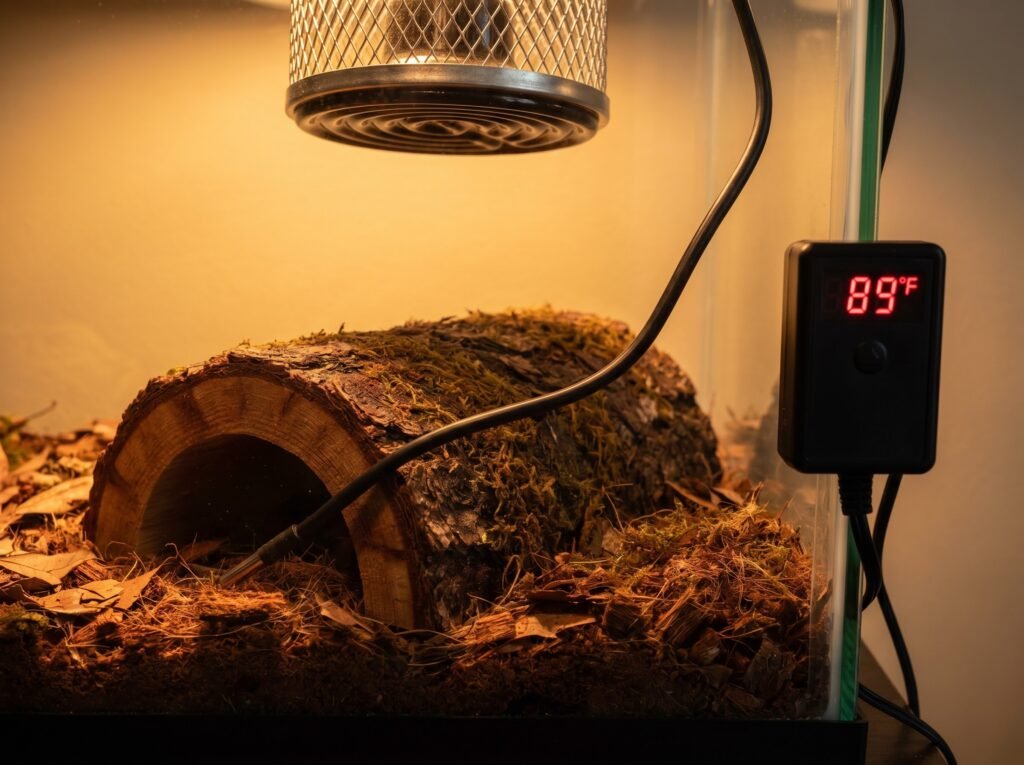
Ball pythons need a real temperature gradient running from warm to cool, never one uniform temperature throughout. Without a true cool end, the snake cannot thermoregulate, a basic physiological need.
Here is where the two main sources differ slightly, and it is worth naming openly. Zen Habitats' heating guide puts the warm hide ambient at 86-90°F, with a basking surface reaching 95-104°F. ReptiFiles' care sheet (hosted by Zen Habitats and based on African habitat climate data) reflects a similar warm-hide air temperature range. Most husbandry references put the warm hide at 88-92°F. These are not contradictory. The difference is measurement point: surface temperature at the hot spot runs higher than the air temperature inside the hide above it. Aim for a warm hide air temperature of 88-90°F, confirm it with a digital probe thermometer placed inside the hide, and trust that reading over a surface gun pointed at the basking spot.
The cool end should stay around 72-80°F. Nighttime drops to 70-78°F are fine and actually reflect the natural temperature swing in West African savannas. Air conditioning below 70°F is a problem and calls for a supplemental heat source.
Every heat source, heat mat, ceramic heat emitter, halogen bulb, radiant heat panel, must be connected to a thermostat. No exceptions. The thermostat probe goes inside or directly under the warm hide. An unregulated heat mat can climb well past 120°F. Never use a heat rock. They heat unevenly and cannot be safely regulated; severe contact burns are a documented result, per Zen Habitats. The full heating and thermostat guide lives at /ball-python-temperature-heating.
Hides, the part most setups get wrong
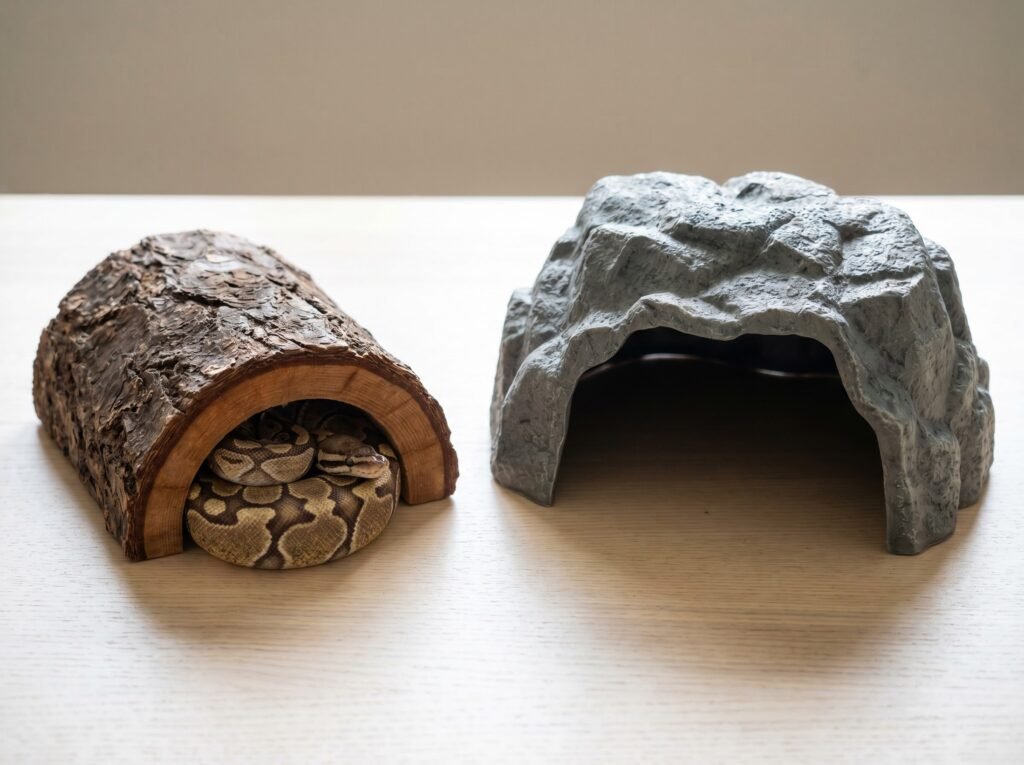
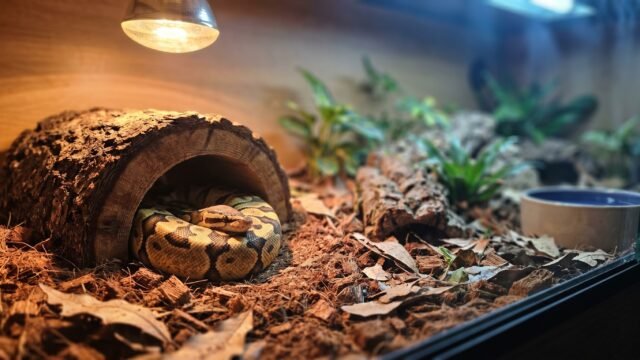
Two hides is the minimum. One on the warm end, one on the cool end. In practice, three or four is better. The more options a ball python has, the less time it spends sitting in the open looking exposed.
Size is the thing most beginners miss. A hide should be snug, meaning the snake fills it when coiled. It should feel the sides touching its body. A hide the size of a shoebox for a juvenile snake gives no security at all, because the animal has room to move around inside it rather than being pressed against the walls. When in doubt, go smaller rather than larger for the hide itself, even if the enclosure is large.
The third hide is the humid hide. Place it in the middle of the enclosure or toward the cool end. Pack it with moist sphagnum moss. This is where your snake will spend the three to five days before a shed, and a well-maintained humid hide is the difference between a clean one-piece shed and a patchy mess that traps over the eyes. Replace the moss when it starts to smell or looks gray. For detailed hide placement diagrams and size matching by snake length, see our ball python hides guide.
Substrate
Loose, naturalistic substrate does two jobs: it holds humidity and it lets the snake burrow. Ball pythons in the wild spend their days in termite mounds and animal burrows. Substrate that lets them dig down and disappear reduces stress significantly.
Zen Habitats' substrate guide recommends a layer at least 2-4 inches deep, using organic topsoil, coco coir, cypress mulch, or a blend of all three. A layer of dried leaf litter on top adds texture and lets the snake feel hidden even on the surface. For a bioactive setup, a mix of roughly 80% soil to 20% play sand with a cleanup crew of isopods and springtails handles waste and keeps the substrate healthy longer.
Avoid pine or cedar shavings, both contain aromatic oils that irritate respiratory tissue. Reptile carpet looks tidy but traps bacteria, holds almost no humidity, and poses a real strangulation risk if a loose thread catches a tooth or claw. Paper towels work fine as a temporary quarantine substrate, but they cannot hold humidity and offer nothing for burrowing. The deep-dive on every substrate option, with humidity retention data, is at /best-substrate-for-ball-pythons.
Humidity
Baseline enclosure humidity should sit between 60% and 80%. Climate records from ball python habitat in West Africa show daytime humidity in that range, spiking to 80-100% at night, a pattern you can replicate by misting lightly each evening. During a shed cycle, keep humidity toward the higher end of that range and check that the humid hide stays moist throughout.
Too much humidity with poor ventilation is its own problem. Stagnant wet air leads to scale rot and respiratory infections. A good PVC enclosure with a mesh panel at the top gives you the humidity retention you need without trapping the air. Monitor with a digital hygrometer; the probe belongs in the middle of the enclosure, rather than in the humid hide, for a representative average reading. For the full humidity and shedding guide, including signs of a stuck shed and how to help, visit /ball-python-humidity-shedding.
Water bowl, clutter, and the rest
Water bowl: heavy ceramic, large enough for the adult snake to coil inside. Ball pythons soak before shedding and when mildly dehydrated. A small dish that only covers their head is not adequate. Heavy is important, because a flipped bowl soaks the substrate and drops your humidity unpredictably.
Clutter is functional. Cork bark rounds, flat cork slabs, branches, and live or artificial plants break up the open floor space so the snake never has to cross the enclosure in the open. A ball python moving through a gap between two cork pieces experiences something close to its natural environment. Adding more hides and cork coverage is also the solution when a large enclosure triggers stress or food refusal, because the open space becomes broken into smaller, navigable zones. For specific enrichment ideas including climbing structures and buried hides, see our clutter and enrichment guide. If you want to go further and build a living ecosystem instead of a static setup, our bioactive enclosure guide covers the full process.
Putting it all together
Build the enclosure before you bring the snake home. Get it to the correct temperatures and humidity for three to five days running before the snake goes in. A snake placed into an unstable enclosure is already starting stressed. Once it is in, give it two weeks to settle without unnecessary handling. Keep hides covered and minimize disturbance. Most feeding problems that keepers report in the first month trace back to a setup that was not ready.
Check temperatures and humidity every day for the first two weeks. Thermostats drift, probes shift, and seasonal changes in room temperature affect your gradient more than you expect. A baseline log of your numbers is worth keeping for the first month. If something looks off in your snake's behavior, you will have data to work from.